Yoga's Chakras Can Be Read Through Anatomical Posture Analysis
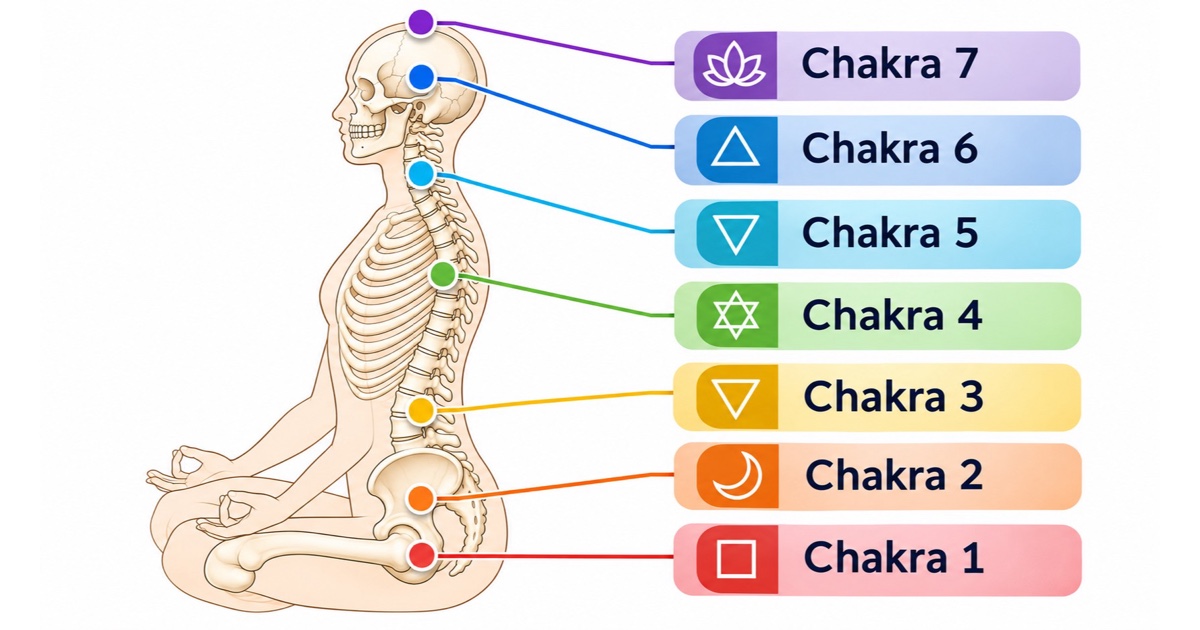
When you hear the word “chakra,” what comes to mind? For many people, it probably suggests “invisible, mystical energy” or “a spiritual idea with no basis in fact.” Even people who are interested in yoga may want to step back a little as soon as chakras come up.
Yet when we look at the chakras from the standpoint of anatomy and posture analysis, we find a surprisingly rational insight into how the body works.
In this article, I will set spiritual assumptions aside and look at the chakras again purely as part of how the body works, in anatomical and kinesiological terms. This is also the thinking behind the smartphone app Hatha Yoga Flow.
Look at the Body from the Side to See What Is Out of Balance
When we check our posture in a mirror, we usually see ourselves from the front. But for postural balance, what matters is not the front view but the view from the side (what anatomy calls the sagittal plane).
To support the body against gravity, the human spine forms a gentle S-curve when seen from the side. As long as this S-curve and the angle of the pelvis are kept in good shape, the skeleton carries our weight efficiently and the muscles do not have to strain.
But once one part falls out of balance, the body starts to compensate somewhere else so that it does not fall over.
Suppose, for example, that the pelvis tilts too far forward (anterior pelvic tilt). Left like that, the upper body would tip forward, so the body unconsciously arches the lower back (the lumbar spine) too much to pull itself back. Then it has to round the upper back (the thoracic spine) to stay balanced, and then push the neck (the cervical spine) forward to keep the eyes looking ahead. One change leads to the next, like a row of falling dominoes.
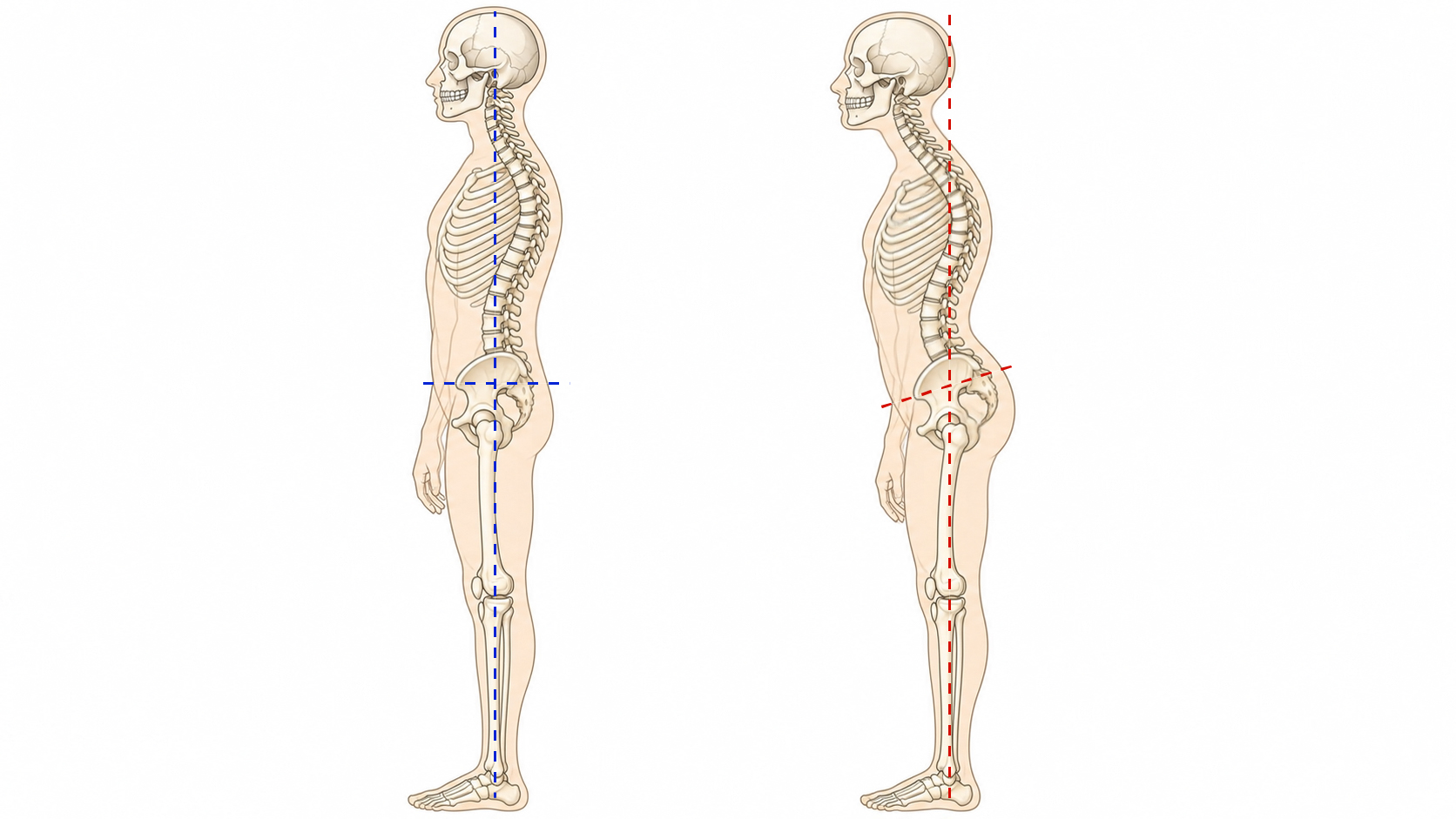
This state of constantly holding up a collapsed posture is what keeps certain muscles tense all the time. It is the real source of chronic stiff shoulders, lower back pain, and tiredness with no obvious cause.
Postural Balance and the Seven Chakras
Now let us lay the “seven chakras” of traditional yoga over the posture seen in the sagittal plane. We will start with the parts that directly shape posture as seen from the side.
In a standing posture we would also have to consider the angles of the knees and ankles. To keep things simple, let us instead picture a seated posture (or a yoga meditation posture) seen from the side. Then we can judge the body's balance only by how it stacks up from the pelvis upward. The easiest to understand are the second through the fifth chakras.
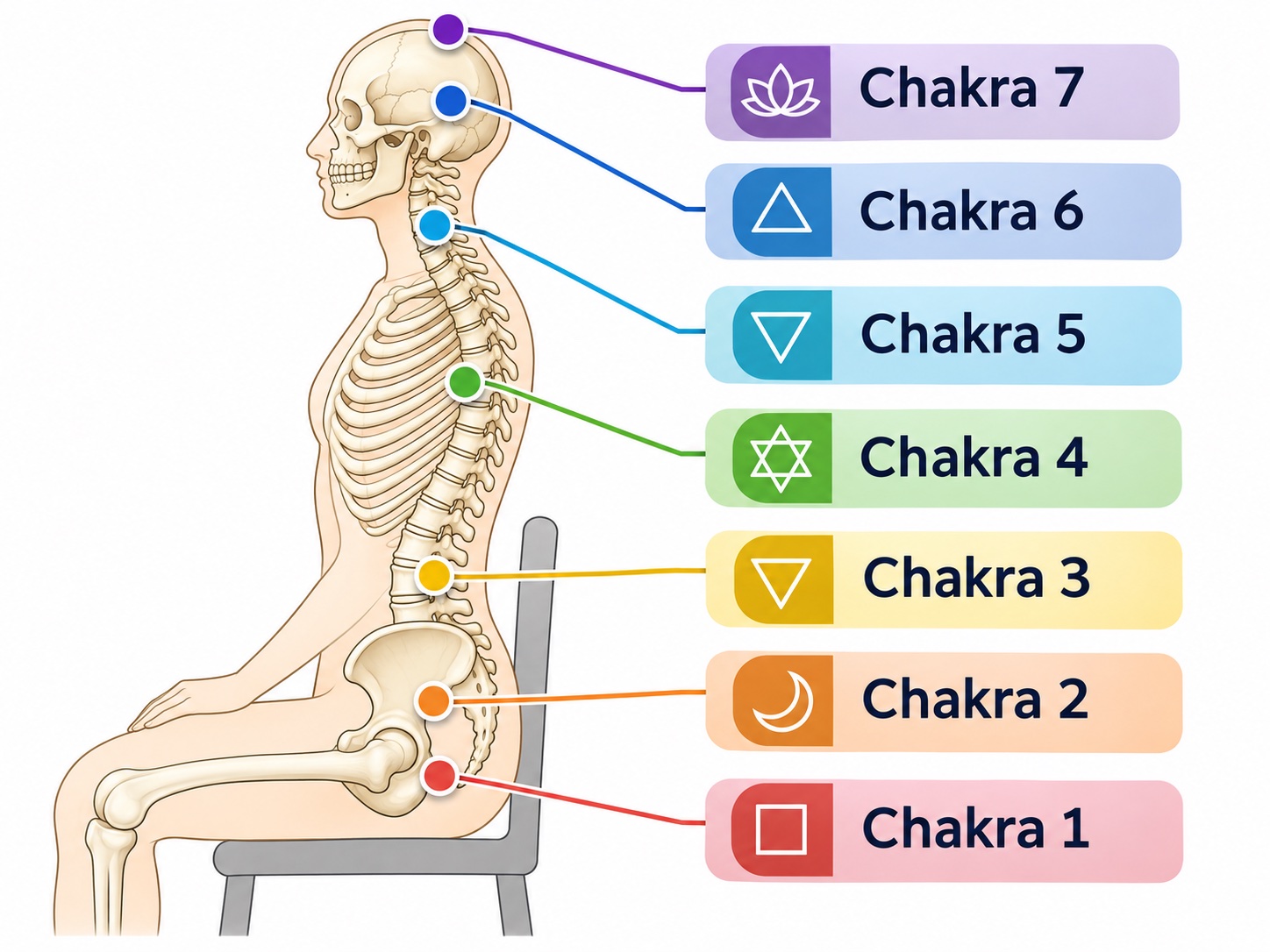
Chakra 2: The tilt of the pelvis and the angle of the hip joints
In a seated posture, the pelvis is like a base plate on which the whole spine rests. Its angle is set by the flexibility and balance of the muscles that cross the hip joints (such as the iliopsoas and the gluteal muscles). If the hips move poorly and the pelvis tilts too far forward or back, this is where the whole spine above it starts to fall out of line, like the first domino.
Chakra 3: The curve of the lumbar spine
The five lumbar vertebrae, stacked directly on the pelvis, normally curve gently forward (lordosis). This lets them absorb weight and impact from above like a spring. When the tilt of the pelvis is off, the curve can become too deep, as in a swayback, or flatten out as the lower back rounds. Either way, nerves can be compressed, and the discs and the muscles around the lower back come under heavy strain.
Chakra 4: The curve of the thoracic spine
The twelve thoracic vertebrae join the ribs to form a cage called the rib cage, and they normally curve gently backward. When desk work rounds the back and the thoracic spine stiffens, the ribs cannot expand easily and breathing becomes shallow. It also gets in the way of the shoulder blades, which rest on top of it, moving smoothly, and that is a major cause of stiff shoulders.
Chakra 5: The curve of the cervical spine
The seven cervical vertebrae curve gently forward so they can hold the head, which weighs about 5 kg (11 lb, roughly a bowling ball), directly above them. When the thoracic spine rounds and the head juts forward (so-called “text neck”), the muscles at the back of the neck must stay tense to hold the head up, which leads straight to chronic neck and shoulder stiffness.
In the sagittal plane of a seated posture, the tilt of the pelvis and the curves of the lumbar, thoracic and cervical spine fully determine the posture of the trunk, because there are no other joints that can move. (Here, I count the joint between the skull and the top vertebra, the atlanto-occipital joint, as part of the cervical curve.) If the physical position of the skeleton is set by the second through the fifth chakras, what roles might the other chakras play?
Chakra 1: The pelvic floor muscles
These muscles stretch across the bottom of the pelvis like a hammock and hold up the internal organs. They do more than support from below: working together with the deep abdominal muscles and the diaphragm, they maintain the pressure inside the abdomen (intra-abdominal pressure) and act as a base that supports the spine from the inside, much like air pressure.
The sixth and seventh chakras relate not to skeletal muscles or joints, but to the work of the brain.
Chakra 6: Coordination of the parts
Also called the guru chakra, it is involved in governing the other chakras. It acts as a control center that coordinates each part of the body and directs them as a single system.
Chakra 7: The sense of balance
This corresponds to the ability to keep your center of gravity and your axis precisely in place under gravity. Even if each part of the body is flexible, you cannot hold a natural posture free of needless tension if this sense of balance is dull.
Seen this way, the seven chakras are not just mysterious centers of energy. They can be understood as a framework that takes in, as a whole, what the body needs to sit, stand, move and breathe under gravity.
Why Balance All Seven Chakras?
When something feels wrong in the body, many people rely on local care: they massage the stiff shoulder or stretch only the aching lower back.
But the human body is connected as one whole system. If there is a problem with the angle of the pelvis or the movement of the thoracic spine, for example, loosening only the neck and shoulders may do little to improve the balance of the body as a whole.
What matters, then, is the habit of looking over the whole body rather than at one part only.
As we have seen, when we match the seven chakras to the structure and functions of the body, we can cover all the main elements: the state of the pelvis and spine, the coordinated movement of each part, and even the sense of balance of the whole body.
In other words, the seven chakras can serve as a framework for seeing the body's balance from several angles and bringing the whole body into balance without leaving anything out.
The smartphone app Hatha Yoga Flow brings this idea into actual yoga practice. There have long been attempts to explain the chakras through nerve plexuses or endocrine glands, but as far as I know, this app is currently the only place where you can practice yoga sequences built systematically on the chakra-based posture analysis presented here.
Hatha Yoga Flow currently offers a 7-day free trial. A good way to start is to spend one week going through all seven approaches.
Hatha Yoga Flow — Personalized yoga for every levelFlowing yoga sequences with voice guidance. A weekly program for all 7 chakras, 3–20 minutes a day, works offline. hatha-yoga-flow.web.app
In this article, I explained that behind the mystical-sounding word “chakra” lies a rational theory of anatomy and kinesiology. In the articles to come, I plan to look more closely at how the chakras relate to the body from this same point of view.